
Your CV/IR Revenue Shouldn't Leave When Your Expert Coder Does
In most specialties, losing a skilled coder is a workforce problem. In CV/IR, it can be a revenue crisis. The procedures are complex, the coding rules are specialty-specific and change annually, and the institutional knowledge required to code them correctly can take years to develop. The program doesn't actually have that expertise. One person does, and the revenue leaves when they do.
Nearly half of health information organizations experiencing understaffing reported it led directly to decreased reimbursement, slower claims processing, and increased claims denials, according to AHIMA's 2023 workforce survey. It's no surprise that HFMA now finds 33% of provider executives naming workforce a top-3 revenue cycle concern in 2026. A coding error is a compliance exposure and a revenue event.
How CV/IR Programs Lose Their Coding Expertise
Your senior CV/IR coder leaves or retires
The departing coder took years of knowledge with them: how your physicians document, which bundling rules apply to your most common procedures, the modifier logic for your specific payer mix, and the unwritten rules that kept your denial rate manageable. Their replacement starts from scratch. The first visible cost is usually a growing queue of discharged-not-final-billed (DNFB) cases, clinically complete but sitting unbilled because no one on the team can close them accurately. Those cases represent revenue the program has already earned but hasn't been able to collect.
You can't find a qualified CV/IR coder to hire
Qualified candidates are scarce, salaries are high, and experienced CV/IR coders are typically employed. AAPC's own data confirms it, with Certified Professional Coders holding a 2.5% unemployment rate in 2024, well below the 4.2% national rate. Dr. Zielske has also observed a decline in CIRCC-credentialed coders in recent years, driven in part by retirements among the coders who hold the credential. Many programs end up with general coders reviewing procedures they're not equipped to code accurately.
Even a successful hire doesn't close the gap right away. Replacing a departing coder, including recruiting and onboarding, typically costs $15,000 to $22,000 per departure, and new hires code at only 60% to 70% of full capacity for their first 60 to 90 days. In a specialty as narrow as CV/IR, that ramp period often runs longer. Experian Health's own survey of revenue cycle executives found that 92% of respondents said new staff members make errors that negatively impact claims processing.
Your coding team hasn't kept pace with the rules
Dr. Zielske recently audited a physician group at the request of a new CEO who discovered that none of the organization's coders had attended a coding conference or accessed updated reference materials in years. The audit found a greater than 80% case error rate. The coders hadn't lost their edge, the rules had simply outpaced them. CIRCC-credentialed coders are required to earn continuing education units annually to maintain the credential, and this group had quietly fallen behind that standard. In CV/IR, where coding rules change significantly every year, including 2026's overhaul of 46 lower extremity revascularization codes, outdated knowledge is a liability. It drives up denials and raises audit exposure at the same time.
Your program is growing faster than your coding team can scale
As CV/IR procedure volumes grow and case complexity rises, especially with this year's CPT coding updates, the per-case time required for accurate coding rises with it. The expertise needed to keep pace, however, takes years to build in any one coder, and growth doesn't wait for that timeline. New physicians, new procedure volumes, and new payer relationships accumulate faster than any coder or team can absorb them. Programs that don't build scalable coding infrastructure into their growth plans end up outrunning the very expertise their revenue depends on.
Outsourcing Doesn't Solve The Expertise Problem
Half of hospitals have already turned to outsourcing coding in an attempt to address talent and capacity gaps. Outsourcing only solves the problem if the vendor's coders are CV/IR specialists, and more often than not, they're the same kind of general coder the program just replaced. Coding vendors serve many specialties across many clients, and CIRCC-credentialed coders are as hard to find in a vendor's talent pool as they are in any hospital's.
"You wouldn't want your mammographer doing your interventional radiology procedures, and you don't want a general coder reviewing your interventional radiology reports. The expertise required is specialty-specific."
Dr. David Zielske, Founder and CEO of ZHealth Documentation
The same gap shows up in denial management, where 39% of programs have outsourced appeals. A vendor team unfamiliar with a program's physicians, payer relationships, and documentation patterns is no better equipped to win back a complex CV/IR denial than it was to code the case correctly in the first place.
Outsourcing also means losing direct visibility into what's being coded and appealed on the program's behalf, control that's difficult to get back once specialty coding work sits outside the organization. The underlying problem was never a numbers issue. Adding coders, whether in-house or outsourced, doesn't fix an expertise gap.
Coding Quality Lives In The System
Not every error traces back to coder capability. Dr. Zielske has also observed cases where point-of-service charging is generated independent of what the physician actually documented, a process gap that no amount of coder staffing or training fixes on its own. Process gaps anywhere from documentation to claim submission can introduce errors that have nothing to do with who's coding the case. A fully staffed, well-trained coding team still can't produce accurate revenue if the provider doesn't document the procedure fully.
To resolve these process gaps is to move coding knowledge from people into systems. When the rules for coding are embedded in software, not memorized by a specialist, the departure of that specialist doesn't take the coding accuracy with them. The system enforces the rules regardless of who's reviewing the case.
Go back to the four scenarios above, and the system addresses each one directly. When your senior coder leaves or retires, the coding logic stays behind: NCCI edits, bundling logic, and modifier requirements are embedded in the system. When you can't find a qualified hire, a new coder still works from that same embedded logic, even while they build the judgment that comes with time and experience. There's no falling behind when the system updates itself. For yearly code updates, including the largest coding overhaul in over a decade that dropped earlier this year, the system updates automatically, with the new coding rules mastered on day one. And when your program grows faster than your coding team can scale, coders shift from building every code from memory to auditing what the system has already applied.
This doesn't eliminate the need for skilled coders, it protects what makes them valuable in the first place. When the routine coding logic is handled by a validated system, coders can focus on complex cases, compliance review, payer escalation, and the judgment-intensive work that actually requires their expertise.
The Etch Effect
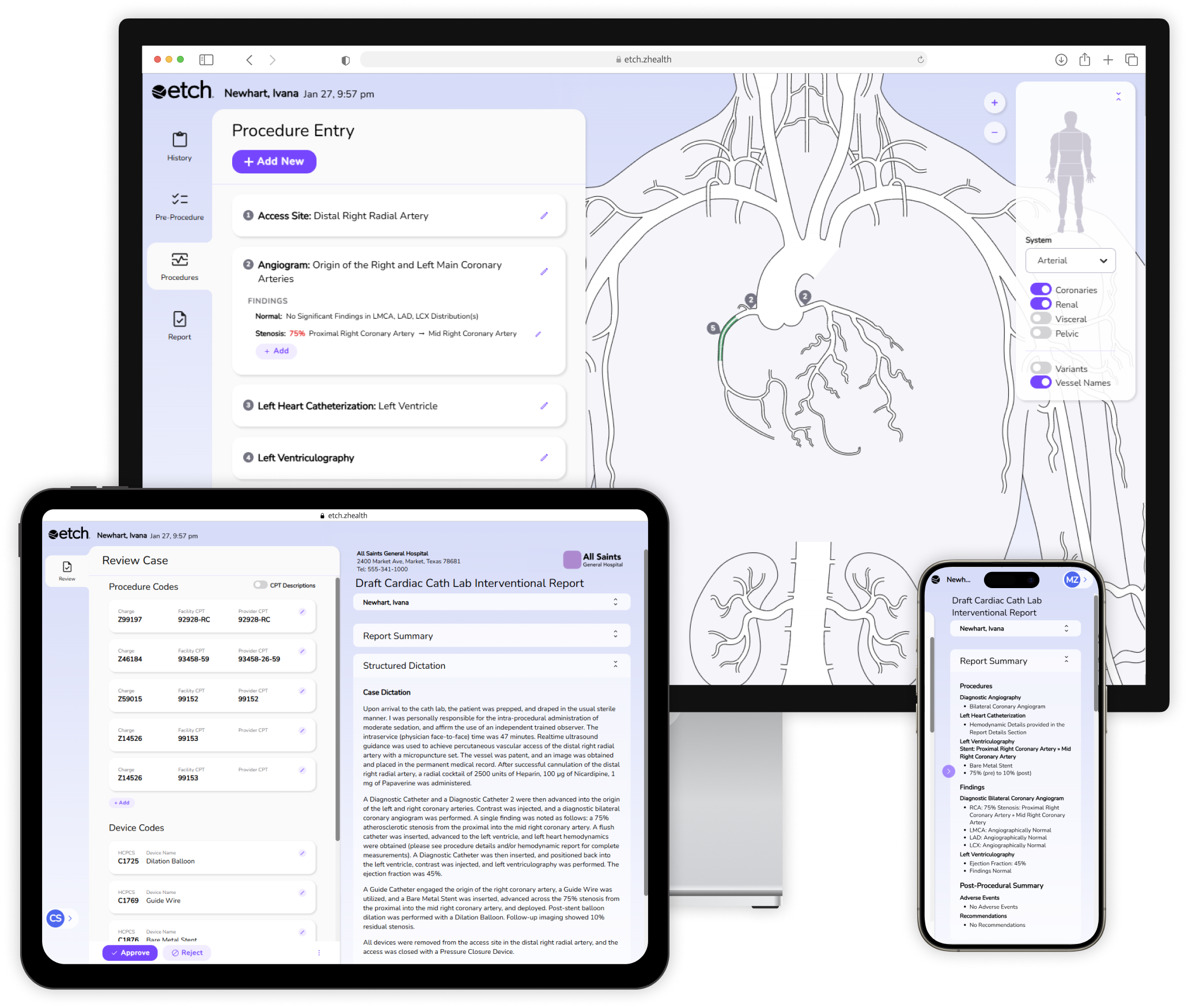
As physicians document in Etch, they are guided through the specific clinical details that determine code assignment. Once documentation is complete, Etch's patented code engine automatically applies the correct codes with 99%+ accuracy. When CPT codes change, Etch updates automatically, without requiring the coding team to retrain from scratch. Because Etch generates the code from the documentation itself, a charge can never get ahead of what's actually been recorded. Coders using Etch shift from building every code from memory to auditing and validating system-applied logic.
References
Guidehouse and Healthcare Financial Management Association. 2026 Revenue Cycle Management Trends. Guidehouse, 2026, guidehouse.com.
MedCodex Health. Medical Coding Outsourcing Cost in 2026: A CFO Breakdown. MedCodex Health, 2026, medcodexhealth.com.
American Health Information Management Association, and NORC at the University of Chicago. Health Information Workforce: Survey Results on Workforce Challenges and the Role of Emerging Technologies. AHIMA, Oct. 2023, ahima.org.
Experian Health. Short-Staffed for the Long Term. Experian Health, Nov. 2023, experian.com.
AAPC. 2025 Medical Coding and Billing Salary Report. AAPC, Feb. 2025, aapc.com.