
The Denial Trap: Escalating Costs of Reworking Case Documentation
Every denied claim has a starting point, and it's almost never the billing department. It starts earlier, well before a claim is ever submitted. Revenue cycle teams pour resources into fighting denials after the fact: querying physicians, appealing rejections, chasing incomplete documentation. Almost none of that effort reaches the actual source of the problem.
Where Denials Actually Begin
Instead of dictating the precise percent stenosis measurement, the procedure note reads "moderate stenosis," a description with no coding value. Physicians are trained and paid to make clinical decisions in real time, not billing decisions, and it's unreasonable to expect a brief dictation between cases to contain all necessary details for coding accuracy. By the time a coder opens that same case, there's little they can do with it. They can query the physician, which adds days of delay and friction, but they can't create documentation that was never captured. If the claim goes out anyway, incomplete or unsupported, the payer has grounds to deny it. The gap between clinical judgment and coding precision is exactly where revenue quietly disappears.
"Denials have increased across the board, and even more so in complex interventions, resulting in lost revenue for both physicians and hospitals."
Dr. David Zielske, Founder and CEO, ZHealth
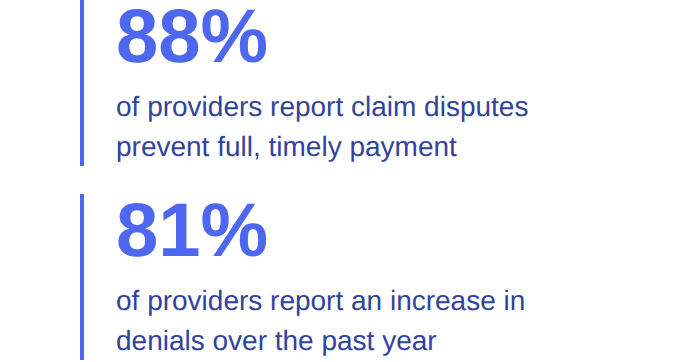
In the 2026 Healthcare Financial Management Association (HFMA) Revenue Cycle Management survey, 191 provider executives were asked what's standing between them and getting paid. 88% said disagreements over claims are keeping their organizations from getting paid on time and in full, with 81% reporting an increase in denials over the past year. Payer challenges have now topped that list for two consecutive years, getting worse instead of better.
According to Experian Health's State of Claims, 41% of providers reported denial rates of 10% or higher in 2025, a 37% increase from 2022. HFMA found an even sharper jump at a stricter threshold, with the share of providers reporting denial rates above 5% growing 67% over the past year. The methodologies differ, but the conclusion is the same. Denial rates are rising no matter how you measure them.
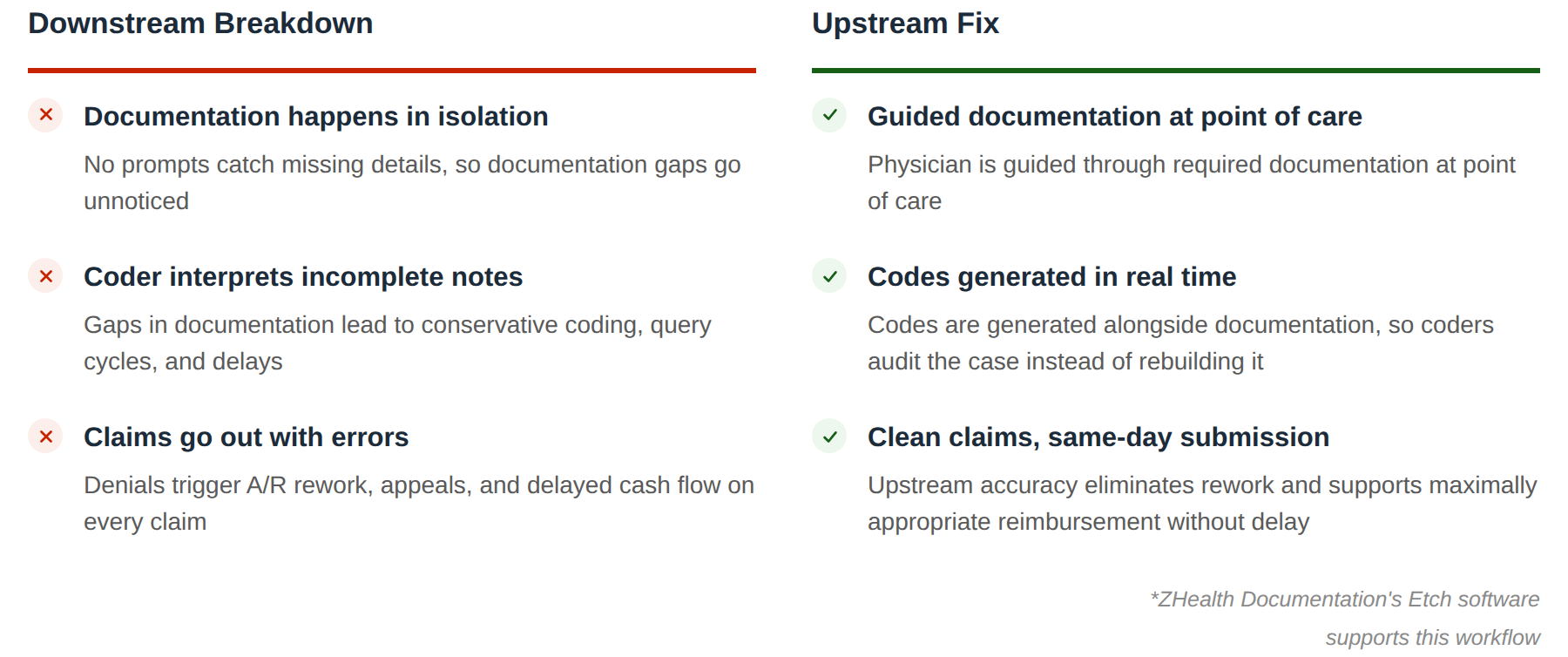
Here's what most organizations get wrong. They treat denials as a billing problem, so they throw back-end resources at a front-end failure. The fix isn't downstream: it's in the procedure room.
The Cost Of Getting Paid
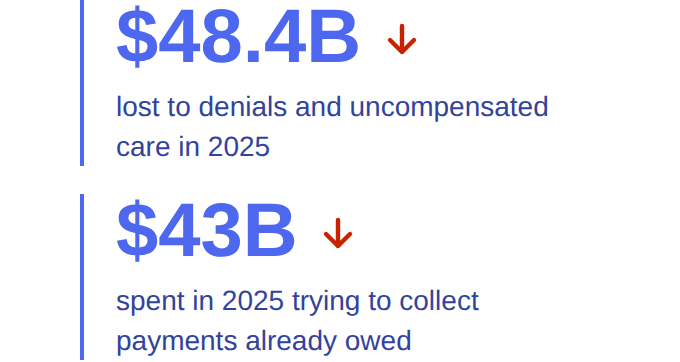
None of this is unique to one hospital or one case. Denials and uncompensated care drove $48.4 billion in net revenue leakage across U.S. hospitals in 2025, according to Kodiak Solutions' analysis of more than 2,300 hospitals. That figure is up 25% from 2024, and it's accelerating faster than most revenue cycle teams can adjust.
The $48.4 billion figure only tells half the story. According to AHA's Costs of Caring report, hospitals sank $43 billion into chasing down money that insurers were contractually obligated to pay, and $18 billion of that, 42%, went specifically toward overturning denials that never should have been issued. None of it went toward patient care.
ZHealth has seen this up close. An audit of over 500,000 cases over 25 years found vague language quietly costing real money in 50–60% of cases, with an average loss of $8,000 per underbilled case. These findings are consistent across every service line reviewed.
The procedure happened and the care was real, but the documentation never proved it. Now providers are paying twice, once in the revenue they never collected and again in the cost of fighting to get it back. In complex service lines, a single case can carry dozens of billable, code-specific details, and each miss compounds the loss.
A Denial Today, An Audit Tomorrow
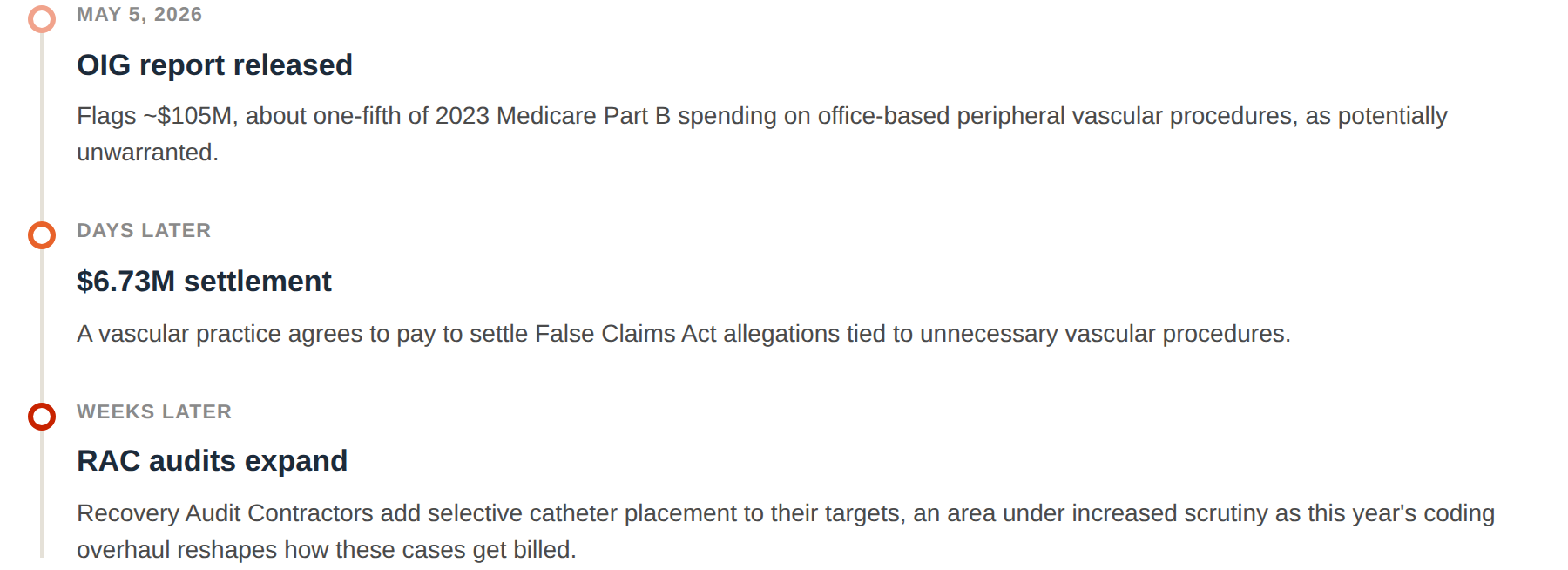
418 CPT code changes reshaped the landscape this year, the most disruptive coding cycle in over a decade. Disruption on that scale rarely goes unnoticed, and regulators were paying attention. A report from the OIG in May, which flagged nearly $105 million in potentially unwarranted vascular procedure payments, a $6.73M False Claims Act settlement, and an audit expansion by Recovery Audit Contractors (RACs) all landed within weeks of each other. This is the regulatory environment these programs are operating inside.
The report hasn't gone unchallenged. Five medical societies, including SCAI and SIR, pushed back in a joint statement, arguing that the OIG's claims-based analysis cannot distinguish specialized practices treating genuinely complex cases from practices performing unnecessary procedures for profit. Without clinical context, a review of claims data alone can flag care that follows clinical guidelines as suspicious just because it looks different from the average case. That kind of exposure is why documentation has to be defensible before an audit ever starts, especially as audit activity keeps expanding.
Revenue Cycle Leaders Are Responding
The HFMA survey found that 47% of provider executives are already investing in clinical documentation improvement, revenue integrity, and charge capture. Revenue cycle leaders are now treating this as a strategic priority. That shift means investing before a claim goes out, not after it's denied.
The choice that decides revenue happens in the procedure room, whether documentation captures the precise clinical detail or falls short of it. Everything downstream of that choice, the query, the denial, the appeal, the audit, is the cost of missing it at the point of care.
The Etch Effect
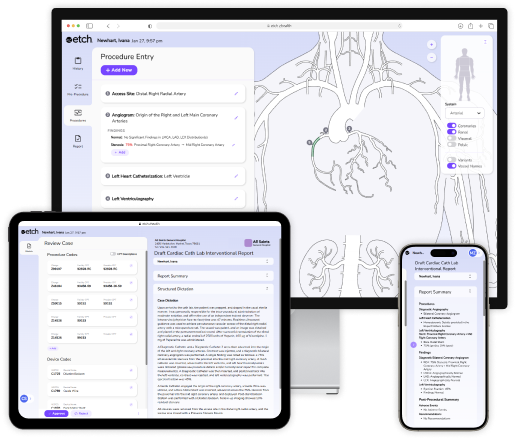
Etch is purpose-built to support maximally appropriate reimbursement and support same-day claim submission. As physicians document, Etch guides them through the specific clinical details that determine code assignment, including stenosis documentation, exact vessel location and territory, and interventional procedures. Once documentation is complete, Etch automatically applies the correct codes with 99%+ accuracy. As coding requirements change, Etch updates in the background, protecting your program from compliance risk and revenue leakage without disrupting your workflow.
References
Guidehouse and Healthcare Financial Management Association. 2026 Revenue Cycle Management Trends. Guidehouse, 2026, guidehouse.com.
American Hospital Association. 2025 Hospital and Health System Spending on Insurer Administrative Requirements. AHA, 2026, aha.org.
Experian Health. State of Claims 2025. Survey of 250 healthcare revenue cycle professionals, June–July 2025, experian.com.
"What 10 Revenue Cycle Experts Reveal About Denials and Rising A/R Days in 2026." BillingParadise, 4 June 2026, billingparadise.com.
"Cardiology Billing in 2026: Top 5 Revenue Leaks That Cost Cardiologists $50K+ Annually." 24/7 Medical Billing Services, 2026, 247medicalbillingservices.com.
Kodiak Solutions. State of the Healthcare Revenue Cycle. Kodiak Solutions Revenue Cycle Analytics, Mar. 2026, kodiaksolutions.io.
U.S. Department of Health and Human Services, Office of Inspector General. Utilization Trends and Medicare Part B Billing for Office-Based Peripheral Vascular Procedures Raise Questions About Program Integrity. Report OEI-01-24-00250, 5 May 2026, oig.hhs.gov.
Society for Cardiovascular Angiography and Interventions, Society of Interventional Radiology, Society for Vascular Surgery, Association of Black Cardiologists, and Outpatient Endovascular and Interventional Society. Joint Statement on the HHS OIG Report on Peripheral Vascular Procedures. SCAI, June 2026, scai.org.