
Complete Care, Incomplete Documentation: The Hidden Source of Improper Payments
When Medicaid pays a claim improperly, fraud is rarely the reason. In fiscal year 2025, CMS traced 77.2% of those improper payments to insufficient documentation, according to an October 7 report from the Congressional Research Service. In many of those cases, the service may well have been delivered to an eligible patient; the record simply couldn't prove it.
It would be easy to read that as good news, since a paperwork problem sounds easier to fix than fraud. But a payment that fails on paperwork is still improper, and it can still be taken back. As federal and state oversight tightens, the record behind each claim is what decides whether the revenue stays or gets recouped.
What "Improper" Actually Means
Federal rules define an improper payment as any payment that shouldn't have been made or was made in the wrong amount, overpayments and underpayments alike. CMS measures Medicaid's rate through the Payment Error Rate Measurement (PERM) program. In fiscal year 2025, that rate was 6.12%, or $37.39 billion, up from 5.09% the year before.
PERM reviewers pull a sample of claims and request the medical records behind them. If the records never arrive, or don't contain what the claim requires, the claim is scored as an error. In 2025, fewer than a quarter of Medicaid improper payments could be shown to be wrong. The other 77.2%, about $28.9 billion, couldn't be judged either way because the documentation wasn't there. As the Center on Budget and Policy Priorities points out, most of these were payments for eligible services delivered to eligible people. With complete records, many of those claims could have been paid.
Insufficient documentation has accounted for most Medicaid improper payments in every CMS report since 2021, from 88% that year to 77.2% in 2025. That held even as the overall improper payment rate fell from 21.69% to 6.12%, a drop that partly reflects changes in how CMS measured and enforced eligibility during and after the pandemic.
CMS counts every claim with missing or insufficient provider documentation as a PERM error, and state Medicaid agencies warn providers that payments tied to those errors may be recouped. Fraud or not, a paperwork finding can cost a program just as much as any other improper payment.
When the note doesn't capture everything that was done, the code can't either, and the program is paid less than the work supports. Underpayments are a much smaller share of the total, about $1 billion of Medicare's $28.8 billion in FY 2025 Comprehensive Error Rate Testing (CERT) findings, but they rarely surface on their own.
Medicare Shows the Same Pattern
Medicare's CERT program reviews a sample of fee-for-service claims the same way and put the FY 2025 Medicare FFS improper payment rate at 6.55%, or $28.83 billion. Insufficient documentation was the largest error category by far, at 53% of improper payments. Incorrect coding accounted for 11.1%. CMS's 2025 CERT supplemental data shows where that documentation risk concentrates, and cardiovascular procedures are near the top of the list.
Percutaneous intracardiac procedures, catheter-based work inside the heart such as left atrial appendage closure, transcatheter mitral valve repair and cardiac ablation, had the highest improper payment rate of any inpatient service type CMS reported, and the most projected improper payments. The top root cause was documentation required by the National Coverage Determination that was inadequate. For endovascular valve replacement, the most common miss was the preoperative surgeon's office notes.
An insufficient documentation finding doesn't mean a procedure was unnecessary, only that the record didn't show what the coverage rules require. In CV & IR, what's missing is specific. A peripheral case can span several vessels, multiple catheter placements, image guidance, and add-on codes, and the record has to support every one of them. If the note leaves out how selective the catheter placement was, which vessel territory was treated, or why the intervention was medically necessary, a well-performed procedure turns into a claim the record can't back up.
"I always say, 'Not documented, didn’t happen.' You can do everything right in the cath lab, but if the note doesn’t show it, the payment can still be taken back, even years later."
Dr. David Zielske, Founder and CEO of ZHealth Documentation
The Scrutiny Is Getting Sharper
For years, a PERM finding was mostly a state's problem, but that is starting to change. The 2025 federal budget reconciliation law requires HHS, beginning October 1, 2029, to cut federal Medicaid funding to states whose PERM eligibility error rates exceed 3%. It effectively eliminates the "good faith" waivers that let states avoid that penalty in the past, and it counts insufficient documentation errors in the calculation. KFF reports that 12 states were already above the threshold in their most recent audit. The Congressional Budget Office (CBO) estimates the change will reduce federal Medicaid spending by $7.6 billion over ten years.
The penalty targets eligibility errors, not provider claims. But states facing a bill have every reason to tighten review everywhere, and enforcement is already moving downstream:
- April 2026: CMS Administrator Mehmet Oz said every state would have 30 days to submit a plan to revalidate the providers in its Medicaid program, expanding a crackdown that had focused on a handful of states.
- October 2026: After CMS deferred $550 million in Medicaid funds, Minnesota's Department of Human Services said it may need to claw back payments from providers if CMS turns the deferral, a temporary hold on federal funds, into a permanent denial. The state's human services commissioner noted that these actions often involve issues that are never established as fraud.
- Ongoing: Medicaid program integrity remains on the High Risk List kept by the Government Accountability Office (GAO), most recently updated in February 2025.
- Built in: States are required to contract with Recovery Audit Contractors (RACs) to identify overpayments and underpayments and recoup overpayments, so the audit exposure familiar from Medicare exists on the Medicaid side too.
For CV & IR programs, the takeaway has less to do with Medicaid eligibility policy than with who is doing the reviewing. Federal contractors, state agencies, and the auditors states hire are all under pressure to find errors, and insufficient documentation is the error they find most.
Paid Isn't Final
Most programs judge documentation risk at the front end: did the claim go out, and did it get paid. Improper payment reviews run on a different clock. PERM, CERT, RACs, or a state's contracted auditor can request the record years after the payment cleared and check it against the rules that applied when the claim was billed. If the record falls short, money that already arrived can go back.
That makes recoupment a different problem from a denial. As we covered in The Denial Trap, our August newsletter on the rising cost of reworking case documentation, a denial lands in the work queue right away and can be worked. A recoupment surfaces long after the case closed, when the details live only in the record. There's no query to send and nothing new to add. An appeal can only argue from what was written at the time.
That leaves one real window to get the record right: during the procedure, while the details are still in front of the team. Nowhere does that window matter more than in CV & IR, where procedures bring in some of the highest revenue in the hospital and their complexity leaves more room for details to go missing.
With states facing new federal penalties and reviewers at every level looking harder, those cases will be judged on what the report shows, however well the procedure itself went. Documentation drives far more improper payments than fraud, and it's the part a program can actually fix.
Want to know how your CV & IR documentation would hold up to a records request? Reach out to our ZHealth Documentation team and we'll walk through it with you.
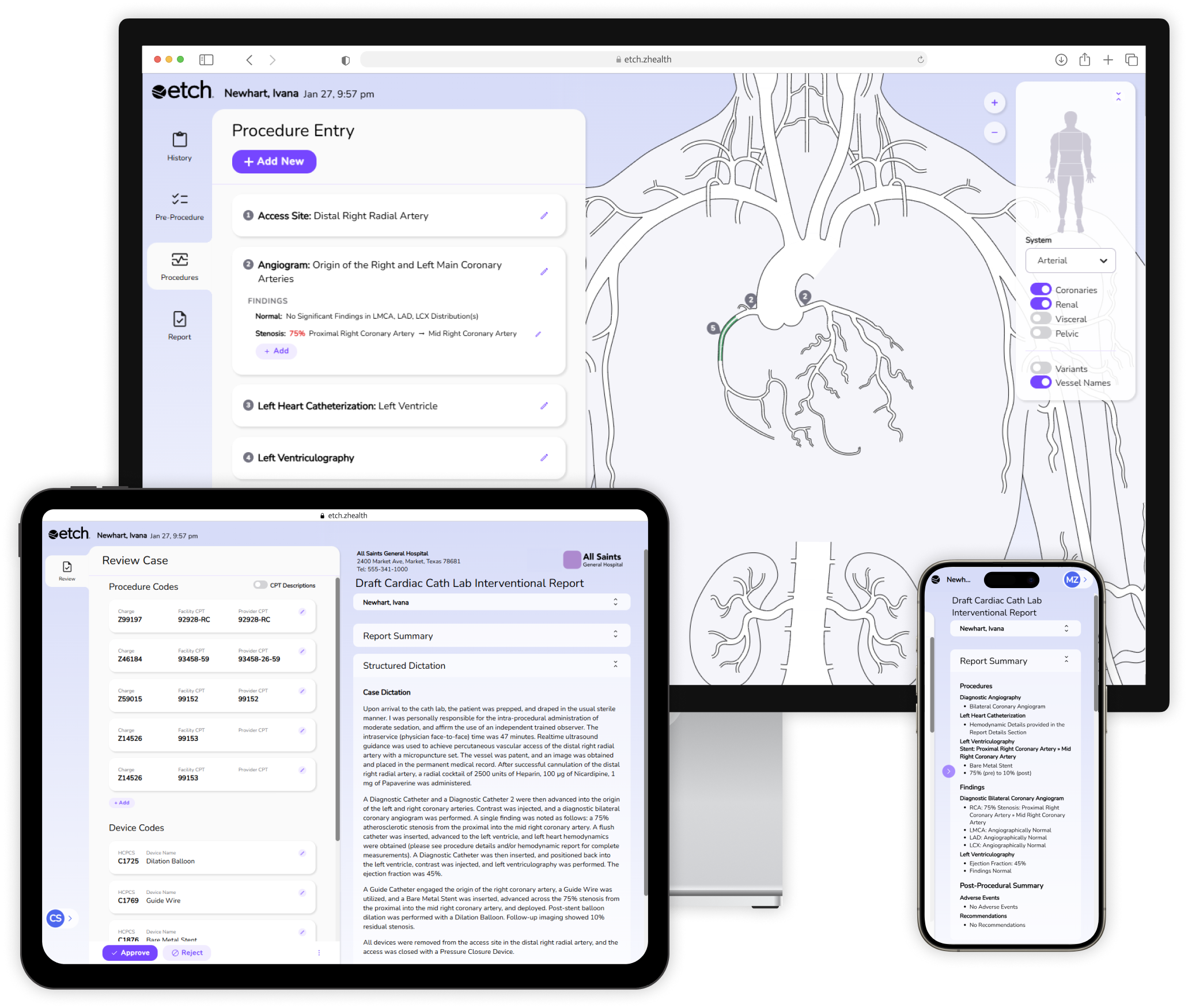
The Etch Effect
Etch builds the record a reviewer will ask for years from now. As the provider documents, Etch-Guided Documentation walks them through the clinical details each procedure requires, so those details are captured at the time of the procedure instead of reconstructed later. Anything missing is flagged to the provider or compliance team before the report is finalized, while the case is still fresh enough to fix. Codes are assigned automatically with 99%+ accuracy and are always based on the latest coding rules. When a PERM, CERT, or RAC records request arrives, the documentation already says what the claim needs it to say.
References
Congressional Research Service, In Focus IF13326, Medicaid program integrity, October 7, 2026. congress.gov
Becker's Hospital Review, "77% of Medicaid improper payments tied to paperwork, not fraud: Report," October 8, 2026. beckerspayer.com
Centers for Medicare & Medicaid Services, Fiscal Year 2023, 2024 and 2025 Improper Payments Fact Sheets; 2022 improper payment rate release (November 15, 2022); PERM Error Rate Findings and Reports; PERM Overview for Providers; and 2025 Medicare Fee-for-Service Supplemental Improper Payment Data. cms.gov
Fierce Healthcare, "Improper Medicare payments down $20.7B since 2014, CMS data show." fiercehealthcare.com
KFF, "A Look at the Medicaid Payment Error Rate Measurement (PERM) Program and Upcoming Changes and Impacts," February 13, 2026. kff.org
Center on Budget and Policy Priorities, "Understanding the Medicaid Payment Error Rate Measure," Off the Charts. cbpp.org
Wisconsin Department of Health Services, ForwardHealth, "Payment Error Rate Measurement (PERM)." forwardhealth.wi.gov
States Newsroom, "In Medicaid fraud crackdown, feds now looking to audit all 50 states," April 22, 2026. newsfromthestates.com
Becker's Hospital Review, "Minnesota may need to claw back Medicaid funds from providers," October 16, 2026. beckershospitalreview.com
U.S. Government Accountability Office, "High-Risk Series: Heightened Attention Could Save Billions More and Improve Government Efficiency and Effectiveness," GAO-25-107743, February 25, 2025. gao.gov
The Commonwealth Fund, "What H.R. 1's Changes to Medicaid Payment Error Rules Mean for States," July 2026. commonwealthfund.org